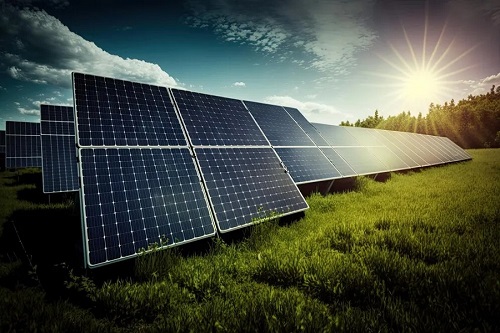

India will require around USD 500 billion in renewable-energy investment by 2030 as it scales up clean power generation and works towards its net-zero ambition, Ministry of New and Renewable Energy (MNRE) Secretary Santosh Kumar Sarangi said. The investment will need to support expansion in renewable generation, storage, transmission and domestic manufacturing as electricity demand rises across emerging sectors.
Clean Energy Investment To Rise
Speaking at the BloombergNEF Summit 2026, Sarangi said the next phase of India's energy transition would be shaped by the need to provide firm and reliable renewable power. He pointed to rising electricity requirements from data centres and green hydrogen as key drivers that will require the country to strengthen its clean-energy ecosystem.
The investment push comes as India accelerates towards its target of 500 GW of non-fossil-fuel-based installed power capacity by 2030. India has now crossed the 300 GW mark in installed non-fossil capacity, putting it more than 60 per cent of the way towards the 2030 target.
BloombergNEF said India has emerged as the leading data-centre market in the Asia-Pacific region outside China. The country's live data-centre IT capacity has quadrupled over the past six years to 1.7GW. Another 1.3 GW is under construction, while a further 3.2 GW of projects have secured the land, power and permits required for construction.
Maharashtra remains the country's dominant data-centre market, accounting for 55 per cent of India's live IT capacity. Andhra Pradesh, Gujarat, Karnataka, Tamil Nadu, Telangana and Uttar Pradesh are also expected to play important roles in the next phase of growth.
The investment pipeline is substantial. Domestic conglomerates Adani and Reliance have committed USD 210 billion to data-centre development in India, while Google, Amazon and Microsoft have also announced USD 84 billion. Around 95 per cent of all announced investment is targeting large hyperscale AI campuses.
Data Centres Push Electricity Demand
The expansion of data centres is expected to create a major new source of electricity demand. BloombergNEF projects India's data-centre electricity consumption to rise more than eightfold, from 11 TWh in 2025 to 91 TWh in 2035, as hyperscale capacity comes online. Sarangi said renewable energy would be critical to meeting the requirements of these emerging load centres. He linked the need for clean power to both the expansion of data centres and the development of India's green hydrogen ecosystem.
“Given the projections that we are seeing in terms of the green hydrogen production system in the country, the data centres which are going to come out in the country, I think RE is going to play an integral role in having the ability to provide firm and reliable power to all these load centres which are coming up in the near future,” the secretary said.
The government is targeting 5 million metric tonnes of annual green hydrogen production by 2030 under the National Green Hydrogen Mission. The expansion of the sector is expected to create another significant source of electricity demand as production facilities scale up.Sarangi said the country was also moving towards renewable-energy procurement models that can provide more consistent power. India has shifted towards hybrid, round-the-clock and other tenders as buyers’ requirements evolve.
Storage Key To Reliable Power
Battery energy storage is expected to be a key part of this transition. Sarangi said he foresees “a gigantic growth” in battery energy storage system (BESS) installations in India, with storage enabling renewable projects to provide firm and reliable power. The government has also introduced financial support to improve the commercial viability of storage. In June 2025, it approved a Rs 5,400 crore viability-gap funding scheme for 30 GWh of battery energy storage systems, with support of up to Rs 18 lakh per MWh.
The government has also extended the waiver of inter-state transmission charges for eligible battery energy storage and pumped-storage projects. For BESS projects, the waiver has been extended until June 2028, supporting the economics of storage deployment. India's storage market would not be limited to lithium-ion batteries. Sarangi pointed to growing interest in sodium-ion and vanadium-based technologies and expects the cost of some of these technologies to become competitive with lithium-ion batteries over the next two to three years.
Transmission infrastructure will also be critical as renewable generation expands. The government's transmission roadmap for integrating more than 500GW of renewable capacity by 2030 envisages around 50,890 circuit km of transmission lines and 4,33,575 MVA of substation capacity, at an estimated cost of Rs 2.44 lakh crore.
The need for faster grid expansion is underscored by rising renewable-energy curtailment. India curtailed 8,133 GWh of solar power between April and June 2026, with 2,417 GWh curtailed in April, 3,235 GWh in May and 2,481 GWh in June, according to government data. The government attributed the curtailment to grid-security requirements and a mismatch between the commissioning of transmission lines and renewable-energy projects.
Sarangi said delays in transmission lines were contributing to curtailment in some renewable projects. He added that expediting transmission infrastructure would help address the issue and improve the utilisation of renewable generation.
Beyond transmission, the government is also focusing on domestic manufacturing. Sarangi said policy interventions would continue to focus on deployment, manufacturing and market creation, including measures covering solar, wind, hydrogen and battery storage.