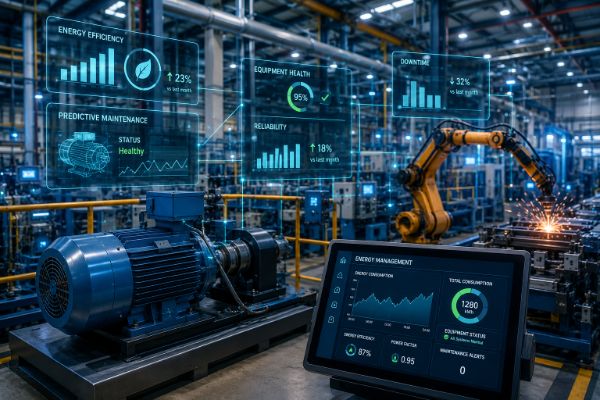

For Indian manufacturers, the next productivity race may not be about adding more machines, capacity or factory floor space. It will be about squeezing more output from the energy and equipment they already use. As manufacturing scales and energy costs weigh on margins, energy productivity is moving from the factory utility room to the balance sheet. Equipment running inefficiently, unexpected machine failures, frictional losses and maintenance carried out only after something breaks can quietly increase energy consumption while eating into production hours.
The opportunity, therefore, is not simply to consume less electricity. It is to produce more from each unit consumed. Automation, predictive maintenance, efficient equipment and real-time energy management are increasingly allowing manufacturers to attack energy costs and operational inefficiencies at the same time.
The Hidden Cost Of An Inefficient Factory
Indian industry has expanded manufacturing capacity rapidly, but parts of the industrial base continue to operate with legacy equipment, reactive maintenance practices and limited visibility into where energy is being consumed. The result can be a double hit: inefficient machinery consumes more energy while equipment failures interrupt production. In energy-intensive manufacturing, even relatively small efficiency gains multiplied across motors, machinery and production lines can translate into substantial operating savings.
India’s energy-productivity performance varies significantly across sectors. India’s cement industry is around 14 per cent more energy productive than the global average and is at par with other top-performing countries, while Indian EV manufacturers are also competing strongly on energy-efficient vehicle design. Steel remains slightly above global averages on energy use, although the sector is gradually catching up. Further gains are likely to come from technology adoption, renewable energy and smarter operations and maintenance using IoT and AI, even as some decarbonisation pathways such as green hydrogen-based DRI require high upfront investment and may take longer to generate returns. Lower-carbon products such as green steel could, however, command a market premium, while SBTi commitments are also pushing companies towards deeper value-chain decarbonisation. Anujesh Dwivedi, Partner, Deloitte India, said, “Energy productivity in India is sector-specific — some industries already outperform global benchmarks, while others are steadily catching up.”
Simarpreet Singh, Executive Director and CEO, Hartek Power, said, “Energy productivity is no longer a back-office metric — it is central to competitiveness.” Improvement will require manufacturers to look at energy infrastructure as part of the production system itself. Smarter electrical infrastructure can reduce losses at the point of consumption, while automation can help equipment respond more precisely to actual operating requirements rather than running continuously at inefficient loads. Real-time monitoring adds another layer. Instead of discovering high consumption through an electricity bill at the end of the month, manufacturers can identify which machines, processes or shifts are driving it while production is underway.
Fix It Before It Fails
One of the biggest productivity drains inside a factory can occur before a machine stops altogether. Equipment operating with excessive friction, poor lubrication or deteriorating components can consume more energy while continuing to function. Left undetected, the same problem can eventually cause failure and bring part of the production line to a halt.
This is shifting the maintenance model from repairing equipment after failure towards identifying deterioration before it causes disruption. Sensors, condition monitoring and predictive analytics can flag abnormal performance and allow maintenance to be scheduled around production rather than production being disrupted by maintenance. But sophisticated software is only part of the equation. Everyday mechanical inefficiencies remain a significant source of lost productivity. Advanced bearing technologies, for instance, can reduce frictional losses and address surface damage that affects reliability and equipment life. SKF's CeraDrive technology can address up to 70 per cent of surface damage-related issues.
Girish Hanchate, Director – Industrial Market, India, SKF India (Industrial), said, “The factories that succeed tomorrow will be those that maximize output, reliability and efficiency from every unit of energy consumed.” The economics can be significant: lower friction reduces wasted energy, healthier equipment lasts longer and fewer unexpected failures mean more production hours from the same asset base.
From Automated Factories To Intelligent Factories
The larger shift is towards factories where energy and production systems no longer operate as separate silos. Digitalisation can give manufacturers visibility into energy flows across operations, while automation can adjust production systems in response to changing conditions. Artificial intelligence adds the ability to analyse large volumes of operational data, identify patterns and anticipate equipment or energy-performance problems before they become expensive.
Roshan Varadarajan, Vice President, Industrial Automation, Greater India, Schneider Electric, said, “The next frontier of industrial competitiveness will come from bringing these capabilities together to create connected, intelligent and energy-efficient manufacturing ecosystems.” The transition is being reinforced by electrification, clean and distributed energy, software-defined automation and AI. Together, these technologies can allow factories to optimise when and how energy is consumed while improving asset performance and production reliability.
For manufacturers, that changes the calculation around energy efficiency. Cutting consumption no longer necessarily means cutting production. A more productive factory can simultaneously increase output, reduce wasted energy, extend equipment life and avoid costly downtime. As India pushes to expand its manufacturing footprint, this could become an increasingly important measure of industrial competitiveness. The factories with an edge may not simply be those with the greatest installed capacity, but those capable of extracting the greatest productive value from every machine, every operating hour and every unit of energy they consume.