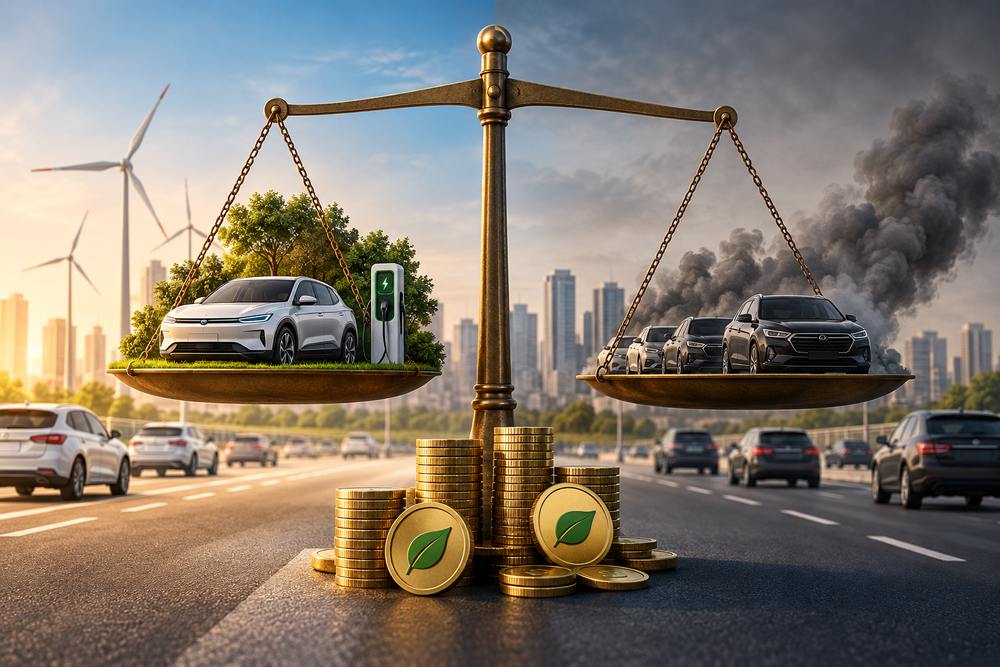

India’s proposed CAFE-III framework could turn fuel-efficiency compliance into a financial calculation for automakers, raising a critical question: will manufacturers invest in cleaner vehicles or find it cheaper to buy their way out of emission shortfalls?
The framework introduces a credit-debit mechanism that allows manufacturers exceeding their fleet-efficiency targets to generate tradable credits, while those falling short can purchase credits or use a prescribed buyout mechanism. The proposed buyout price rises from Rs 2,500 per g CO₂/km in FY28 to Rs 4,500 by FY32, potentially increasing the cost of non-compliance over time.
The implications extend beyond regulatory compliance. Automakers with cleaner portfolios could gain a financial advantage, while those dependent on conventional powertrains may face a choice between investing in technology upgrades and paying for compliance.
Will Credit Trading Drive EV Investment?
The framework's 3x super-credit treatment for battery electric vehicles strengthens their regulatory value, potentially allowing manufacturers with higher EV sales to build compliance surpluses. Akshit Bansal, Founder and CEO, Statiq, said, “The key factor will be the relative economics of the different compliance pathways available to manufacturers.”
For manufacturers, the calculation will involve comparing EV investment costs against credit prices, buyout charges and alternative technologies such as hybrids and cleaner fuels. Himanshu Arya, Founder and CEO, Luxury Cart, said, “If buying credits or using the buyout route becomes more expensive than improving fleet efficiency, manufacturers will have a stronger reason to invest in EVs.”
However, the existence of a credit market does not guarantee accelerated electrification. Its effectiveness will depend on whether credits command meaningful prices and whether manufacturers face sufficient financial pressure to change their product strategies.
A New Revenue Stream, But No Guaranteed EV Boom
Hari Krishna, Founder and CEO, Green Drive Mobility, said, “The impact will ultimately depend on the value and liquidity of the credit market and whether these benefits justify deeper investment in EV technology.” The regulations permit credits to be carried forward within two compliance blocks, FY28-FY30 and FY31-FY32, with unused credits lapsing at the end of each block. Trading and buyouts are restricted to an annual October window.
This creates an opportunity for efficient manufacturers to monetise their compliance advantage, but also raises questions about whether credit purchases could delay investment in cleaner powertrains. The central test will be whether the rising cost of compliance changes capital allocation. If buying credits remains cheaper than developing and scaling cleaner vehicles, the mechanism could provide regulatory flexibility without delivering a corresponding acceleration in electrification.
For India's automobile industry, CAFE-III could therefore create two competing incentives: earn from cleaner vehicles or pay to keep selling less-efficient ones. Which becomes more attractive will determine whether the new credit market drives technological change or merely puts a price on delaying it.