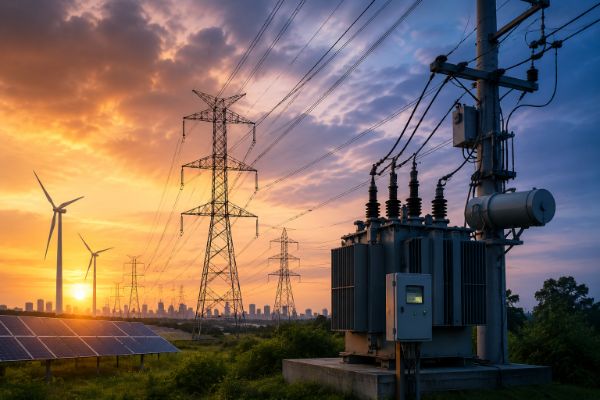

India has spent years adding generation capacity at breakneck speed. Installed power capacity has crossed 550 GW, with more than 300 GW coming from non-fossil sources. But the next bottleneck may not be generation at all. It is whether electricity can actually move through the last mile efficiently, reliably and at the quality consumers and industry increasingly demand. The pressure is mounting on distribution infrastructure as electricity demand rises, renewable power expands and consumption spreads deeper into tier-two and tier-three cities. DISCOM efficiency has improved, but ageing networks, weak visibility, power-quality issues and inadequate last-mile infrastructure could blunt the gains made on the generation side.
Distribution Is Now The Weak Link
India has made progress in cleaning up distribution economics. Aggregate technical and commercial losses fell from 21.91 per cent in FY21 to 15.04 per cent in FY25. Billing efficiency improved from 84.08 per cent to 87.59 per cent, while collection efficiency climbed from 92.9 per cent to 97 per cent. But better financial metrics cannot compensate for an overstretched physical network. Transformers, feeders, substations and distribution lines will have to handle more power, more volatile flows and sharper demand peaks than they were originally built for.
Simarpreet Singh, Executive Director and CEO, Hartek Power, said, “India has done well on the generation side, but distribution remains the weaker link.” The gap is especially significant outside the biggest metros, where fresh commercial, residential and industrial demand is putting pressure on local networks. The challenge becomes sharper as renewable energy scales up. Generation is becoming cleaner and more diversified, but the distribution system must become flexible enough to absorb variable power without compromising voltage, reliability or quality of supply.
Smart Metering Becomes The Eyes Of The Grid
A modern distribution network cannot be run blind. Smart meters give DISCOMs granular visibility into consumption, losses and demand patterns, allowing them to intervene faster instead of reacting after problems have already hit the network. Anil Rawal, Managing Director and CEO, IntelliSmart Infrastructure Pvt Ltd, said, “If the last mile can’t measure it, manage it and price it correctly, that capacity never fully translates into reliability.”
That makes metering only the first layer. The bigger investment requirement is in the digital backbone around it — data platforms, analytics and systems capable of converting millions of data points into real-time operational decisions. Jitendra Kumar Agarwal, Joint Managing Director, Genus Power Infrastructure Ltd, said, “Smart metering [is] emerging as a key enabler.” Better visibility can tighten billing, expose losses faster, improve demand forecasting and give utilities a far clearer picture of how individual pockets of the network are performing.
Reliability Will Need More Than More Megawatts
As electricity use becomes more sophisticated, merely keeping the lights on will no longer be enough. Manufacturing facilities, data centres, commercial complexes and digitally connected homes increasingly require stable voltage, fewer interruptions and better power quality. That puts the focus on upgrading the hardware of distribution alongside its software. Stronger substations, feeders and transformers will need to be combined with battery storage, AI-led grid analytics and modern switchgear to build a network capable of responding dynamically to changing loads.
The Revamped Distribution Sector Scheme has helped create a stronger base for this transition. AT&C losses have fallen sharply and DISCOMs returned to profitability in FY25 for the first time in a decade. The next leg, however, will be harder: converting financial improvement into infrastructure resilience. Udai Singh, Managing Director and CEO, Schneider Electric Infrastructure Ltd and Vice President, Power Systems, Schneider Electric India, said, “The next chapter will be defined not by how much power the country generates, but by how intelligently it delivers that power to every citizen and industry.”
India’s power story is therefore moving from megawatts to delivery. The country may continue to add generation at scale, but unless distribution networks become stronger, smarter and more responsive, capacity on paper will not automatically translate into reliable power on the ground.