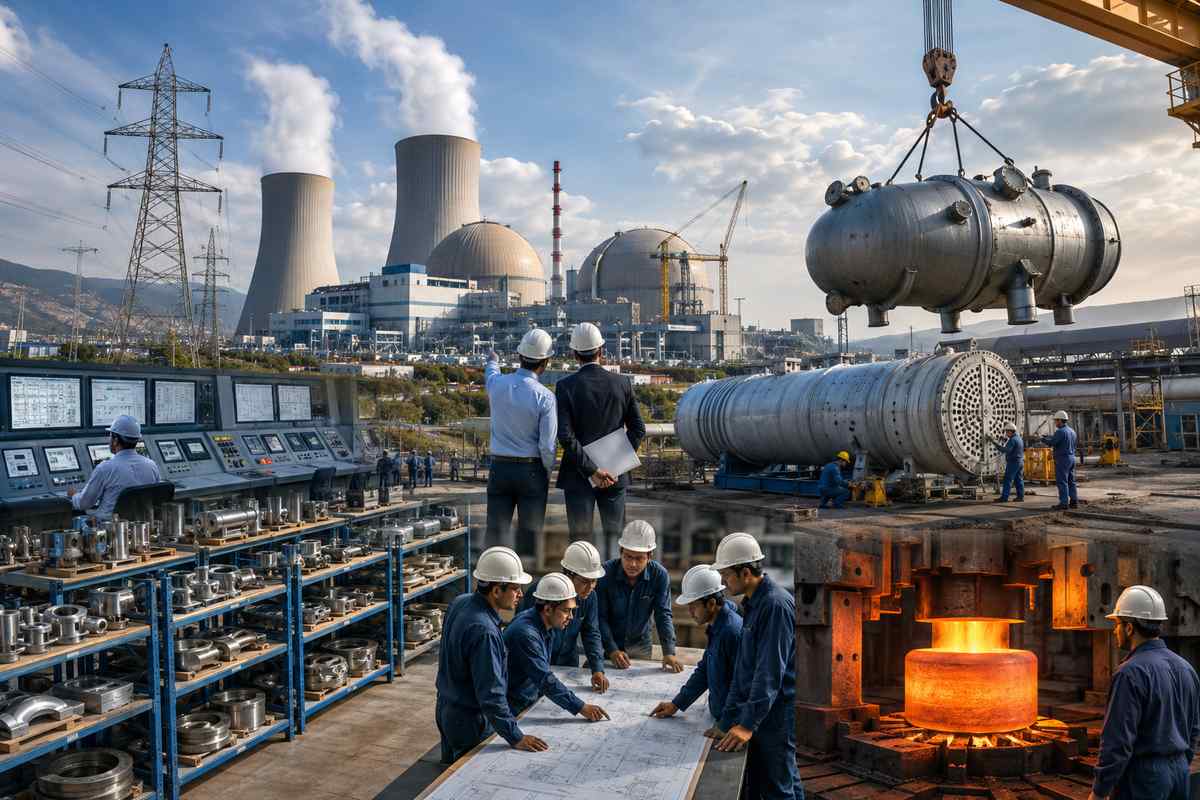

India’s ambition to scale nuclear power capacity from around 8.8 GW to 100 GW by 2047 will test far more than its ability to build reactors. The bigger challenge may be creating an industrial ecosystem capable of supplying nuclear-grade equipment, materials, procuring enriched uranium fuel, manpower and Indian companies in partnership with the Dept of Atomic Energy (DAE) raising the nuclear infrastructure at a pace the country has never attempted before.
The most immediate weakness is specialised heavy manufacturing. Large forgings, reactor pressure vessels, steam generators, turbines, heavy-duty components and nuclear-grade steel require capabilities concentrated among a handful of companies such as L&T, BHEL, Godrej and Walchandnagar Industries. These firms have substantial expertise, but their capacity was built around relatively small and intermittent orders rather than a continuous, high-volume nuclear programme.
“From a procurement and supply-chain perspective, the areas that need the most attention are specialised nuclear-grade manufacturing, qualified vendor capacity, and the broader tier-2 and tier-3 supplier ecosystem,” said Sachin Jain, Co-Founder, Chief Financial Officer (CFO), and Chief Strategy Officer (CSO) at ProcMart.
The distinction between industrial and nuclear-grade manufacturing is critical. Nuclear projects require stringent certification, traceability, testing, quality assurance and long-term reliability. The constraint is therefore not simply whether India can manufacture a component, but whether enough suppliers can manufacture it repeatedly to nuclear standards and at vastly higher volumes.
That makes the depth of the supply chain as important as its biggest manufacturers. Tier-1 companies will need a much wider network of qualified tier-2 and tier-3 suppliers for specialised materials, machining, components and testing. Multiple qualified sources will also be necessary to reduce concentration risk as several projects begin procuring simultaneously.
Manufacturing, Manpower And The Grid Could Become Choke Points
Within this manufacturing base, specialised forgings are among the tightest physical constraints. Heavy presses and furnaces are limited, while existing facilities, including BHEL’s turbine and heavy-equipment lines, were designed around India’s current nuclear fleet rather than the scale implied by a 100 GW target. Testing and certification could add another choke point. Nuclear component qualification has historically been concentrated in government institutions such as BARC and NPCIL. Private testing capacity began emerging with a facility opening in 2025, but a much larger vendor ecosystem will require significantly greater testing and certification bandwidth.
The capacity gap is partly a legacy of how India built nuclear plants. Decades of relatively small and sporadic orders under a state-dominated system gave manufacturers little reason to invest in dedicated forging presses, nuclear-grade steel lines or large-scale specialised production. Low volumes kept costs high, while uncertain demand discouraged private investment. Control systems will also need attention, particularly if Small Modular Reactors (SMRs) become part of the expansion. Their compact designs can require advanced automated, digital and cyber-secure instrumentation and control systems beyond those associated with older analogue PHWR designs.
Then there is manpower. A 100 GW nuclear fleet could require roughly 38,000 specialists, against a training pipeline producing only around 300 qualified engineers annually. Specialised university programmes, industry partnerships and technical training will therefore have to expand alongside manufacturing. Reskilling engineers, technicians and Quality Surveillance (QS) experts from other industries could be a good option.
Regulatory capacity must keep pace as well. The Atomic Energy Regulatory Board (AERB) faces staffing constraints, while SMR-specific safety codes are yet to be finalised. Vendor qualification and approvals will increasingly need to run alongside capacity creation rather than begin only once projects are underway. The power network presents another challenge. Large volumes of new baseload generation cannot simply be commissioned without corresponding evacuation and transmission infrastructure.
“New nuclear capacity will need evacuation and transmission infrastructure to integrate it into the national grid. The focus should therefore be on building a base of qualified suppliers, skilled manpower and supporting infrastructure well ahead of project commissioning so that supply-chain or grid constraints do not become bottlenecks as projects move into execution,” said Simarpreet Singh, Executive Director & CEO, Hartek Power.
Hartek has connected more than 10 GW of solar capacity to the grid, developed infrastructure up to 765 kV and commissioned more than 400 EHV and HV substations across 21 states over 35 years. Its experience also points to the importance of project execution: equipment availability alone will not prevent delays without adequate engineering, project management and skilled personnel on the ground.
Private Capital Needs Certainty, Imports Will Not Vanish Overnight
India’s domestic vendor base is strongest in conventional PHWR equipment, but remains concentrated. Scaling to 100 GW will require bringing many more suppliers through nuclear qualification. Import dependence will also persist in some areas. Domestic uranium production through Uranium Corporation of India Ltd (UCIL) currently meets only around 30 percent of projected PHWR fuel requirements, requiring imports from Kazakhstan, Russia, Canada, Uzbekistan and Australia, important through at least the 2030s. In parallel, domestic mining is expected to roughly double by 2036.
Advanced reactors pose unique challenges. India currently lacks domestic Low Enriched Uranium (LEU) and High-Assay Low-Enriched Uranium (HALEU) production facilities. HALEU, enriched to 5 - 19.9 percent uranium-235, is required by several advanced reactor and SMR designs. The production capacity of these fuels is closely controlled by the USA, Russia and China. Russia is the only country with commercial-scale HALEU output, producing tens of tonnes per year — far above any other nation. It would be advisable that SMRs based on HALEU fuel be avoided for installation in India.
Localisation will therefore have to be gradual, supported by technology partnerships and investment in advanced testing and manufacturing infrastructure. But private companies are unlikely to commit large amounts of capital merely on the strength of a 2047 target. In fact, they need very substantial fiscal support from the government.
“A few things need to shift before private companies risk real capital instead of just accepting contract work as suppliers. First is demand visibility: companies won't invest in dedicated forging presses or nuclear-grade steel lines for orders that arrive one reactor at a time,” said Nitish Rai, Co-Founder and CEO at FreightFox.
A firm multi-reactor pipeline and long-term bulk procurement contracts could break the cycle of low volumes and limited investment. Companies also need clarity on technical specifications, vendor qualification, procurement timelines and long-term demand before committing capital to dedicated equipment and testing facilities.
Private participation will require clearer risk allocation too. Fuel and heavy water remain state-controlled inputs, making compensation mechanisms important if supply delays affect privately developed projects. Transparent pricing, clarity on transmission costs, stronger force-majeure and termination provisions, predictable tax treatment and faster, more parallel approvals would make projects easier for lenders and investors to underwrite. Better visibility into supplier capacity, raw-material availability, quality, lead times and logistics will be equally important. Capacity on paper means little if suppliers cannot deliver consistently when several nuclear projects are being executed at once.
India’s 100 GW target which includes about 20 MW capacity from SMRs is therefore as much an industrial challenge as an energy one. Heavy manufacturing, vendor qualification, long term secured fuel supply, manpower, regulation, transmission and private investment all have to scale together. At 8.8 GW, supply-chain weaknesses can be managed project by project. At 100 GW, the supply chain itself could determine how much of the nuclear ambition actually gets built.