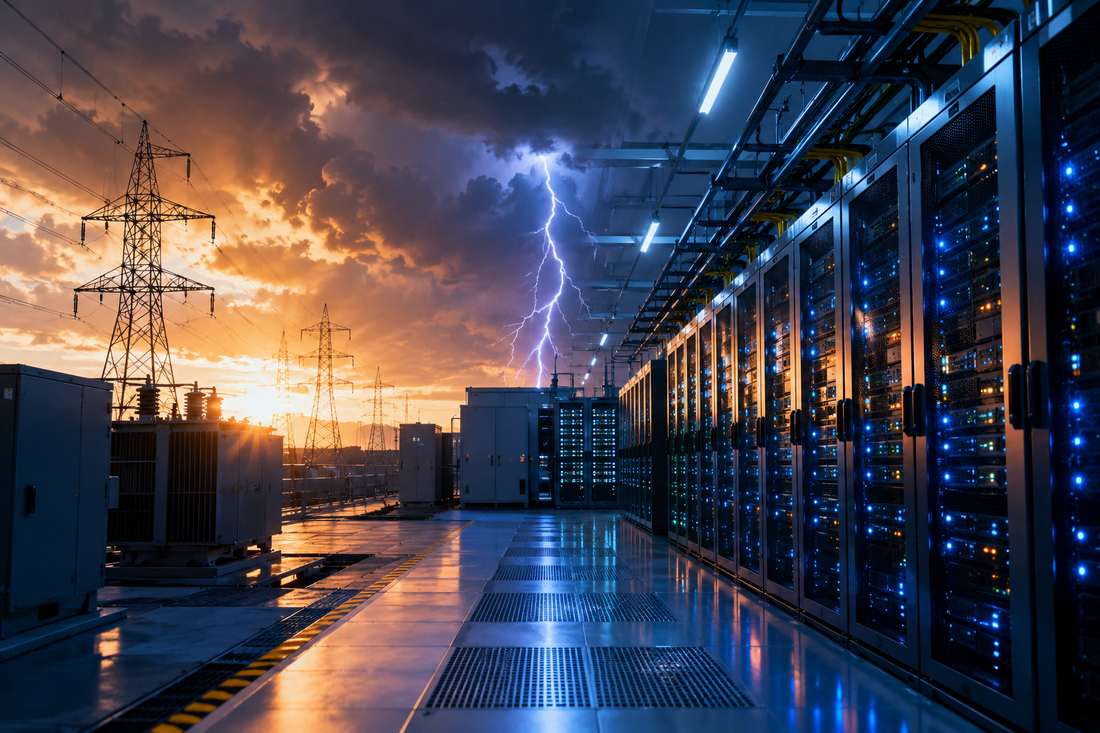

As artificial intelligence pushes data centres towards denser racks and larger electricity loads, India's next infrastructure challenge may extend beyond securing enough power. Increasingly, the question is whether that power can be delivered with the stability and responsiveness AI computing demands.
Data-centre development has traditionally revolved around electricity availability, land, cooling and connectivity. AI changes the electrical equation. GPU clusters concentrate far more computing capacity within individual racks while creating rapid, synchronised changes in demand. This raises exposure to voltage sags, fluctuations, harmonics and transients, while increasing stress on transformers, cooling systems and backup infrastructure.
The implications extend beyond engineering. Grid strength could influence site economics, storage could move from backup to active infrastructure, and states capable of providing both sufficient and stable electricity could strengthen their position in India's expanding data-centre market. There is, however, a counter-view: India's electricity quality is already relatively robust, and the bigger task is strengthening transmission and distribution infrastructure quickly enough to accommodate AI-led demand.
AI Is Rewriting The Data Centre Power Profile
The shift begins at the rack. A traditional Tier-III colocation rack typically draws around 5–10 kW. AI and high-performance computing racks can consume 20–100 kW, while an NVIDIA GB200 NVL72 rack operates at around 120 kW. Greater density concentrates more power electronics within the same footprint, increasing harmonic distortion.
The load behaves differently too. Traditional enterprise computing consists of diverse workloads that tend to smooth aggregate demand. During AI training, thousands of GPUs can ramp simultaneously, producing step-loads and oscillations at a facility's terminals.
“The reason isn't simply more megawatts. It's a different kind of load,” said Sudhanshu Chawla, Managing Director & Partner, BCG. Cooling compounds the challenge. Beyond roughly 25–30 kW per rack, facilities increasingly move towards direct-to-chip liquid cooling, potentially reducing the thermal buffer during an electrical disturbance from minutes to seconds.
AI infrastructure also concentrates substantially more compute behind each electrical connection, meaning a short disturbance can disrupt considerably more computing capacity than in a conventional data centre. One emerging response is distributing selected workloads across modular AI Pods and Nodes. This could reduce concentration risk and improve resilience, although cybersecurity, data protection, orchestration, reliable interconnection and commercial viability remain unresolved.
The scale of synchronised demand could also have consequences beyond individual facilities. In August 2025, Microsoft, OpenAI and NVIDIA raised concerns around synchronised AI training swings interacting with critical utility frequencies. The North American Electric Reliability Corporation has also flagged AI-driven load fluctuations as a potentially high-impact threat to system stability, including cascading disturbances in extreme cases.
“When compute this expensive meets power this volatile, quality becomes a first-order business risk,” said Prof. Manoranjan Dash, Dean, Faculty of Computing and Data Sciences, FLAME University. The risk runs both ways. AI facilities are exposed to incoming disturbances but can themselves become a source of electrical variation as thousands of processors compute and pause together.
That is also changing the potential role of energy storage. Conventional UPS systems were designed primarily as short-duration bridges to generators. Long-duration storage could instead sit between the facility and grid, cycle routinely and absorb variations in compute demand while allowing the network to recharge it more steadily. Offgrid Energy Labs is developing its ZincGel technology around this use case. “Power quality matters more now, and the risk runs in both directions,” said Tejas Kursurkar, Co-Founder, Offgrid Energy Labs.
Growing AI usage, cloud services, high-definition content, social media, faster networks and rising volumes of data processing are simultaneously increasing the requirement for continuous electricity supply. This extends the opportunity into the power-equipment supply chain, including manufacturers such as BHEL, ABB, Andritz Hydro, WEG Brazil, Siemens Energy and Nidec Japan.
Electrical insulation is part of that chain. Mica is used in power machines for insulation and equipment longevity, potentially increasing the strategic importance of India's domestic mica resources as electricity infrastructure expands. Developing this resource could complement India's push to strengthen domestic renewable-energy and electrical-equipment supply chains, including efforts to bring mica into the country's critical-minerals framework.
Milliseconds Can Matter At AI Scale
The challenge is not limited to outages. Voltage sags, transients, fluctuations and harmonics affect infrastructure differently. Voltage sags and short interruptions pose the most immediate operational threat. They can trigger UPS transfers, reset servers, storage and networking equipment, interrupt cooling and terminate active workloads. For long-running AI training, even a brief event can waste substantial computing time and energy.
“Voltage sags and short interruptions create the most immediate risk because they can trigger UPS transfers, cause equipment to reset, interrupt cooling and terminate active workloads,” said Sneh Shah, Whole-Time Director, Aimtron Electronics Limited. Fast transients can damage sensitive controls and communication systems. Harmonics work more gradually, creating heat and efficiency losses in transformers, switchgear, cables and power electronics. Voltage fluctuations may not cause immediate outages but can continuously stress electronic equipment.
A July 2024 incident in Northern Virginia illustrates the scale of the interaction. A failed lightning arrestor produced six voltage sags within 82 seconds, none lasting longer than 66 milliseconds. Around 60 data centres reportedly switched to backup simultaneously, removing roughly 1,500 MW of load from the grid and nearly destabilising the network.
The episode showed how protection can operate correctly at individual facilities while simultaneous responses across a data-centre cluster create a wider grid event. Voltage sags can trip GPU power supplies and terminate multi-week training workloads, while harmonics can progressively overheat transformers and degrade equipment. High-density GPU clusters are also more sensitive to variations in voltage, frequency and electrical noise, making power quality relevant not only to uptime but also system performance and longevity.
“Power is an essential component for AI applications; however, it is not only sufficient but should also be constant and of good quality,” said Padma Reddy Sama, Co-Founder, BharathCloud. Fluctuation is particularly relevant to storage. If a battery supplies a facility for significant periods, rapid AI load swings can be absorbed inside the site while the grid sees a steadier charging requirement.
Voltage sags and fluctuations also bring attention to distribution and transformer infrastructure. Weaknesses as electricity moves from generation through transmission and distribution can translate into variations at the facility. Some operators may consequently turn to substantial on-site generation to reduce dependence on unstable external supply. “The demand for uninterrupted power supply has become far more critical than it ever has before,” said Raoul Prem Menon, Scientific Mica Expert with the Bureau of Indian Standards and Director – Marketing & Head of R&D, Laksola.
Menon estimates the power-generation requirements of AI facilities to be dramatically larger than those of traditional computing infrastructure and sees on-site generation as increasingly important where uninterrupted supply is critical. The expansion of India's transformer network, including higher-capacity infrastructure, will therefore be central to supporting new electricity-intensive facilities.
UPS Protects The Rack, But Resilience Requires The Whole Power Chain
UPS remains indispensable, but its role has limits. Modern systems can handle short voltage dips, spikes and frequency disturbances effectively. Batteries, however, typically provide only minutes of autonomy — enough to bridge the interval before generators start, not sustain a facility through prolonged low voltage or grid faults. Frequent disturbances also increase battery cycling and accelerate wear.
Protection cannot stop at servers. Cooling systems and pumps may not sit behind the same UPS infrastructure and can instead depend on generator backup. Clean server power offers little protection if cooling fails. UPS systems also have finite capacity, overload performance and disturbance-correction ranges. Chronic instability can increase generator usage, battery cycling, thermal stress and maintenance costs. “While UPS systems and power-quality management solutions are essential, they cannot independently address every power-quality challenge,” said Felix Kadam, Managing Director & Co-Founder, CosPower Engineering.
Recent reporting has also documented batteries, generators and cooling systems at AI facilities wearing or malfunctioning earlier than expected under rapid load swings. The Northern Virginia event demonstrated the opposite side of the problem: UPS protection can work exactly as intended while mass switchover itself becomes a grid disturbance. “UPS and conditioning equipment buy time, not immunity,” said Rajesh Chhabra, General Manager, APAC, Large Markets, Acronis.
Long-duration storage addresses a different layer. Six to 16 hours of storage could reduce dependence on incoming electricity for substantial periods, compared with the minutes offered by conventional UPS. Conditioning equipment would still manage downstream power quality, making the technologies complementary: milliseconds and minutes from UPS, hours from storage. This could turn storage from a standby asset into part of normal operation, allowing a site to run from batteries while the grid recharges them steadily rather than following the shape of compute demand.
For facilities requiring even longer continuity, substantial on-site generation remains another option. Resilience therefore has to cover the entire electrical architecture — transformers, HT/LT switchgear, automatic transfer systems, generators, UPS, energy storage, harmonic filters, surge protection, voltage regulation, proper earthing and grounding, continuous monitoring and redundancy from the utility connection to the rack.
India's electricity quality and reliability also compare favourably with several countries already hosting substantial data-centre infrastructure. Harmonics, fluctuations, sags and transients can be managed through established engineering design, monitoring and protection. “I would not consider power quality a major risk for data centres in India,” said Firoj Jena, CEO, Clancy Global.
The larger priority, in this view, is strengthening transmission and distribution, reducing T&D losses and power theft, limiting voltage drops and ensuring network expansion keeps pace with AI-led demand rather than treating power quality itself as an unavoidable bottleneck.
Grid Strength Could Reshape Data Centre Economics
Power quality may ultimately matter most through project economics. India's grid has improved, but electricity quality remains local. Feeder strength, substations, outage histories and redundancy can vary considerably between locations. Renewable-energy integration introduces another balancing requirement as operators seek cleaner electricity without compromising round-the-clock reliability.
Developers are therefore likely to examine grid strength, backup feeders, outage records, substation infrastructure and the ability of local networks to absorb renewables alongside land, connectivity, tariffs and available megawatts. Poor-quality supply can be mitigated, but additional substations, conditioning, storage and backup generation increase capital expenditure, operating costs and energy losses.
Distributed AI infrastructure could offer another route, allowing phased investment, regional deployment and lower concentration risk while supporting sovereign AI capacity. Its security, data-sovereignty, orchestration and commercial challenges remain unresolved, and it will not suit every workload. The opportunity is particularly relevant as established global data-centre markets confront constraints around power, water and permitting.
Developers could also distinguish more sharply between workloads. Colocation and enterprise facilities largely follow demand, while live inference is constrained by latency. AI training has considerably greater siting freedom and can potentially move towards locations with abundant land and electricity. That creates an opportunity to place flexible training loads closer to renewable resources. India's renewable electricity is among the cheapest globally, but it is not available on demand; six to 16 hours of storage could help convert variable generation into firmer supply.
Power reliability could consequently become another competitive differentiator between states. Mumbai remains India's largest data-centre market, while Chennai, Bengaluru and Hyderabad have emerged as major alternatives. Navi Mumbai's hyperscale cluster also benefits from proximity to major substations and relatively stable grid infrastructure. As interruptions become more expensive, states offering stronger supply or dedicated corridors combining captive renewable generation and storage could gain an edge.
“Yes, and this will become even more significant as AI capability increases,” said Sama. Stronger transmission infrastructure could also widen India's data-centre map. Andhra Pradesh and Tamil Nadu are already attracting significant data-centre investment, while India's expansion of higher-capacity networks, including 765 kV transmission infrastructure, could improve the ability to move large quantities of electricity towards emerging demand centres.
Grid weakness ultimately carries a price. Two locations may offer similar capacity and tariffs, but differences in feeder stability, harmonic distortion and utility restoration times can translate into equipment life, maintenance costs and availability. The cheaper electricity contract may therefore not produce the lower operating cost. Land economics reflect the same calculation. A data-centre site is valuable not merely for the plot but for access to cable landings, substations and evacuation infrastructure, and for how much of the power chain a developer must build independently.
“It already does, though it is usually priced rather than stated,” said Devanshu Bansal, Director, UK Realty. A location with weaker incoming supply may still attract development, but dedicated substations, larger generation backup and additional conditioning increase its effective cost regardless of the headline land rate.
Maharashtra illustrates the trade-off. Cushman & Wakefield ranked Mumbai sixth globally for under-construction data-centre capacity last year, with the city accounting for around 42 per cent of India's under-construction pipeline. That concentration has emerged not because Maharashtra is a power-surplus state, but because cable landings, policy support and land allocation make the market attractive enough for operators to absorb additional infrastructure costs.
There is also a case for preventing grid quality from becoming a determinant of geography at all. Stronger coordination across India's power-distribution infrastructure could improve reliability more broadly rather than leave high-growth sectors dependent on individual local networks. A recently completed data-centre project for a central bank, for instance, received effective support from a state-run electricity supply agency, demonstrating that public power infrastructure can support complex projects.
For India's AI data-centre build-out, the challenge is therefore larger than simply producing more electricity. It will require stronger grids, deeper redundancy, storage, sophisticated conditioning and infrastructure capable of supporting increasingly concentrated computing loads. The availability of megawatts remains fundamental. In the AI era, however, the quality of those megawatts — and the cost of making them dependable — is becoming part of the infrastructure equation.