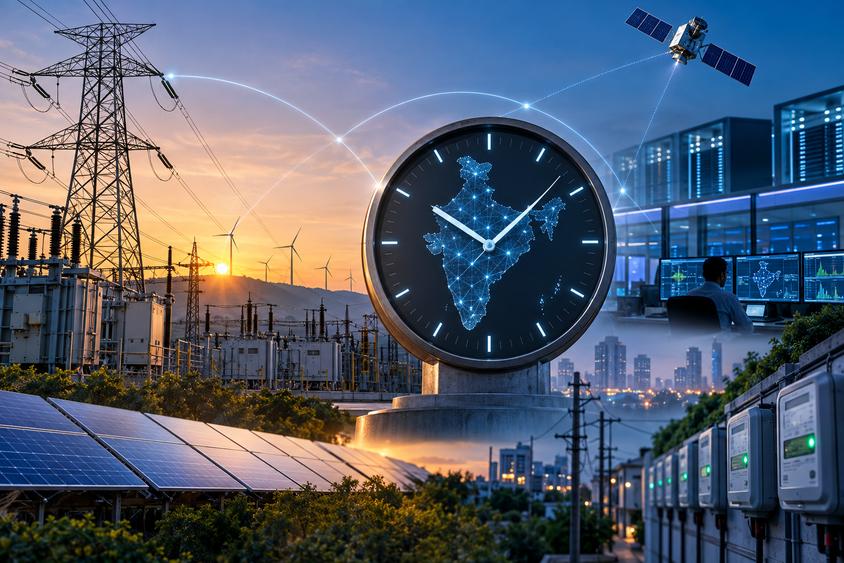

India’s move to establish Indian Standard Time (IST) as the common time reference for critical infrastructure could have consequences well beyond synchronising clocks, creating a new layer of modernisation across the country’s increasingly digital power network.
The shift comes as India’s electricity system becomes far more complex. Renewable generation, power electronics, HVDC systems, digital substations, smart meters, synchrophasors and automated control systems are generating enormous volumes of time-stamped data across the grid. For utilities to accurately reconstruct faults, coordinate protection systems or compare measurements taken hundreds of kilometres apart, those systems increasingly need to operate against the same precise reference of time.
The scale of India's digital power infrastructure makes that requirement significant. More than 20 crore smart meters have been sanctioned under the government's distribution reform programme, with over 7 crore already installed. Alongside them are SCADA systems, Phasor Measurement Units (PMUs), disturbance recorders, protection systems and control centres continuously recording events across generation, transmission and distribution networks.
Legacy Grid Could Need Upgrades
Moving this vast installed base onto a common timing architecture is unlikely to be purely a software exercise. Newer systems that already support modern time-synchronisation protocols may require configuration or firmware changes, while older substations and field equipment could need additional timing hardware, upgrades or, in some cases, replacement.
For equipment manufacturers and grid technology providers, this could add another dimension to India's broader spending on transmission, distribution automation and substation modernisation.
“The electrical grid is fundamentally a synchronised system. Generation, transmission, protection and increasingly distribution depend on events being measured and acted upon against an accurate reference of time,” said Bharanidharan Pandyan, Joint Managing Director, Quality Power Electrical Equipments. “A common national time reference therefore provides more than uniformity of clocks. It creates a common reference against which an increasingly complex electrical system can measure, communicate and respond.”
For utilities, however, the first challenge may simply be determining what is already installed. Power networks typically contain equipment of different vintages supplied by multiple manufacturers, with older devices not necessarily designed to receive time from a network. Utilities will therefore have to map devices that generate or rely on timestamps before determining whether they need software reconfiguration, firmware updates, additional hardware or replacement.
Brajesh Kumar, CEO of Chandigarh Power Distribution Limited (CPDL), said the transition would vary considerably depending on the age of existing infrastructure. “So the first job for most utilities is not buying anything. It is taking stock: listing every device that records a time, then deciding what each one needs. That exercise is unglamorous, but it is what separates a smooth changeover from an expensive one,” Kumar said.
The challenge could be particularly pronounced for utilities operating legacy or mixed-vintage networks. Apart from aligning existing assets with the new timing architecture, power utilities will also need redundancy and contingency mechanisms to maintain synchronisation if their primary timing source is disrupted through failures, jamming, spoofing or cyberattacks.
Precise Time Becomes Critical To A Digital Grid
The importance of synchronisation rises further as utilities deploy PMUs, IoT sensors, artificial intelligence and Digital Twins. PMUs measure voltage and current phasors at geographically dispersed points in the network, making a common time reference fundamental to comparing those measurements accurately.
Digital Twins create a similar requirement. The condition of a physical grid asset has to be associated with the precise moment at which it was measured before that information can be meaningfully replicated and analysed digitally. Standardised timing can therefore help utilities compare distributed measurements, investigate faults, validate sensor information and run more accurate simulations.
“The modern grid architecture is composed of various technologies such as SCADA, smart meters, Phasor Measurement Units, IoT sensors, Artificial Intelligence and Digital Twins that allow for extensive time-stamped data collection,” said Ashish Kumar, Managing Director, OptiValue Tek. “Specifically, PMU-based synchrophasor systems are crucial to time referencing since the PMU measures both voltage and current phasors in a wide area, and without synchronisation, all measurements are worthless in terms of their actual meaning.”
A common reference could also improve interoperability as utilities combine equipment and digital platforms supplied by different manufacturers. Instead of individual systems relying on different clocks, measurements and events across the network can be correlated against the same national reference.
For DISCOMs, that has practical implications for outage management. When meters, feeders, substations and control centres share precise timestamps, operators can more accurately determine which device tripped first and how a disturbance propagated through the network. The same principle becomes increasingly useful for load management as rooftop solar, batteries and other distributed energy resources add more points of generation and consumption to the system.
Cybersecurity Adds Another Dimension
Precise timing is also becoming part of the cybersecurity architecture surrounding critical power infrastructure. SCADA and operational technology systems generate logs that security teams use to reconstruct incidents. If clocks across substations, servers and monitoring platforms differ, events recorded by different systems may appear in the wrong sequence, complicating efforts to determine where an intrusion began or how an attacker moved through a network.
Synchronised timestamps can consequently improve security-event correlation, threat detection and forensic investigation, particularly when combined with security information and event management systems, continuous monitoring, threat hunting and access controls.
“In critical power infrastructure, accurate time synchronisation is not just an operational requirement — it is an important cybersecurity control,” said Manpreet Singh, Co-Founder and Principal Consultant, 5Tattva. “If clocks across substations, control systems and monitoring platforms are out of sync, security teams can struggle to correlate events and distinguish a genuine attack from normal operational activity.”
The shift also carries a wider infrastructure-resilience dimension. India's power system increasingly operates alongside data centres, communication networks, cloud infrastructure and industrial control systems that similarly depend on precise timestamps for computing, communications and transactions.
Creating a dependable domestic time reference could therefore allow critical systems to progressively synchronise against Indian timing infrastructure, including approved domestic sources such as NavIC, while reducing unnecessary reliance on external timing systems.
The significance of the IST push may ultimately lie less in the clocks themselves than in what sits on top of them. As electricity networks, computing infrastructure and automated control systems become increasingly interconnected, trusted time is emerging as a common digital layer linking the physical grid with the systems used to monitor, model, protect and operate it.