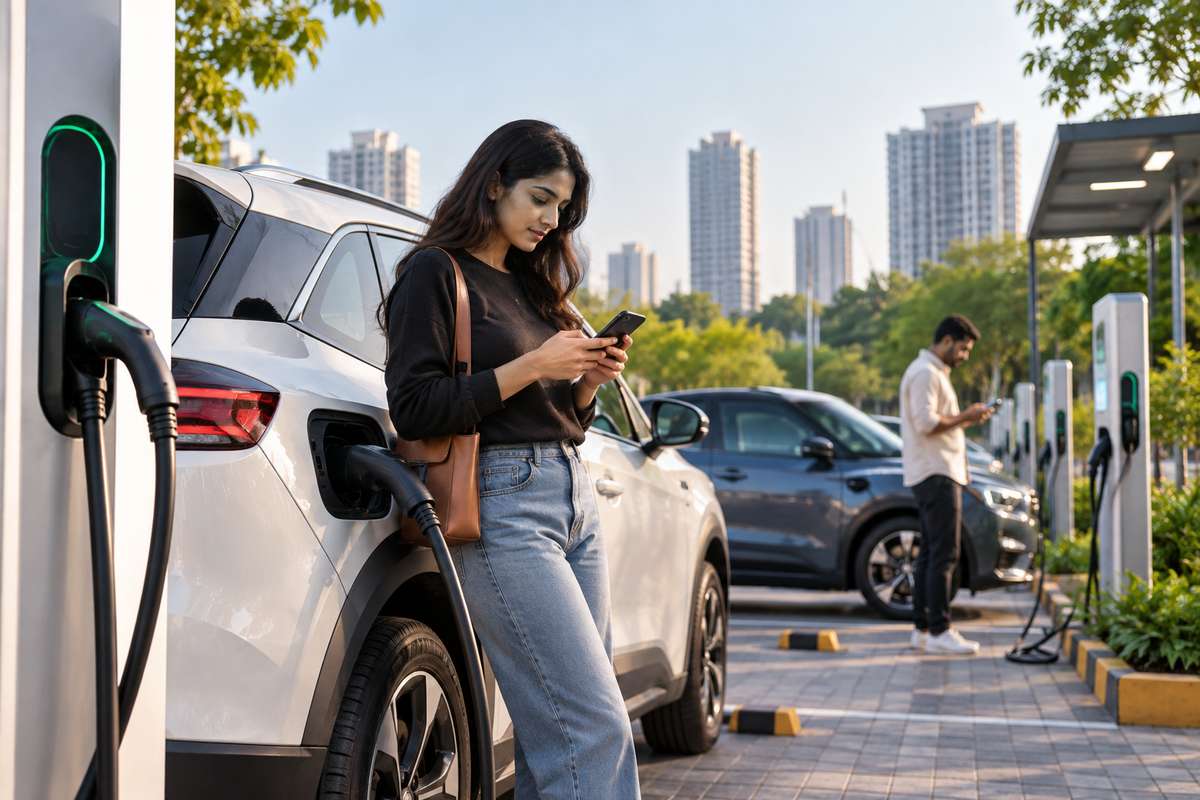

For first owners with dedicated parking, home charging may make EV ownership straightforward. But second-hand buyers could depend far more heavily on public infrastructure, making charger availability and reliability an emerging factor in resale value.
As of July 2026, India had 52,718 public EV charging stations, including 16,561 equipped with fast chargers for cars, according to the Ministry of Heavy Industries. The government has also allocated Rs 2,000 crore under the PM E-DRIVE scheme for further expansion of charging infrastructure.
India’s pre-owned EV market may eventually be shaped by more than battery health and depreciation. As electric vehicles move from first to second owners, access to charging could increasingly determine whether a used EV is practical for the buyer at all.
The issue is particularly relevant in cities, where second owners may live in rented accommodation, apartment complexes without dedicated chargers or homes without assured parking. A vehicle that was convenient for its original owner with home charging may therefore offer a very different ownership experience after resale.
Second Owners May Depend More On Public Charging
Akshit Bansal, Founder and CEO, Statiq, said, “For a first owner with home charging, public infrastructure can be a secondary consideration. For a second owner without dedicated parking, it can determine whether an EV fits their life at all.” He argued that as EVs change hands, proximity to reliable public chargers could increasingly become part of the vehicle’s resale proposition alongside battery health, warranty and price.
This changes how the used-EV market needs to be viewed. Resale value is typically treated as a function of the vehicle itself, but for an EV it can also depend on the infrastructure surrounding the next owner. The usability equation becomes even more important for high-utilisation vehicles. Commercial and shared-mobility operators need predictable charging windows because downtime directly affects revenue generation. Surendar Nath, Executive Director, ETO Motors, said, “For commercial fleets, the key is to match energy availability with vehicle duty cycles so that cleaner charging does not come at the cost of uptime.”
Reliability Could Matter More Than Charger Count
As the charging network expands, the next challenge is likely to shift from simply installing chargers to ensuring they are available, functional and conveniently located. For a used-EV buyer, the existence of a charger several kilometres away may offer little comfort if it is frequently occupied, unavailable or incompatible with the vehicle. Reliable charging access could therefore influence demand for particular EVs in specific locations.
Running-cost economics remain an important advantage for electric vehicles, particularly when compared with petrol or diesel alternatives. Sahil Jindal, Co-Founder, Trevel, said, “With fuel prices swinging on every Middle East headline, the running cost case for EVs has never been stronger.”
But lower operating costs alone may not be enough if charging is inconvenient for the next owner. Charging access will also sit alongside another unresolved issue in the used-EV market — the lack of standardised information on battery condition.
Gunjan Malhotra, Co-founder of Komaki Electric Vehicles, said, “Having a simple and reliable battery health check, along with details of the warranty and replacement cost, would give buyers much more confidence when making a purchase.”
The uncertainty can also spill over into financing. Malhotra said lenders are not yet fully comfortable valuing an EV after it has been on the road for several years, making financing harder to obtain for a used EV than a new one.
As India’s EV fleet matures, the second-hand market will therefore have to solve several uncertainties simultaneously. Battery condition and standardised health assessments will remain central to valuation, while lenders will need better data to price ageing EVs. But for the buyer, another variable may ultimately matter almost as much: whether there is a reliable place to plug the vehicle in.