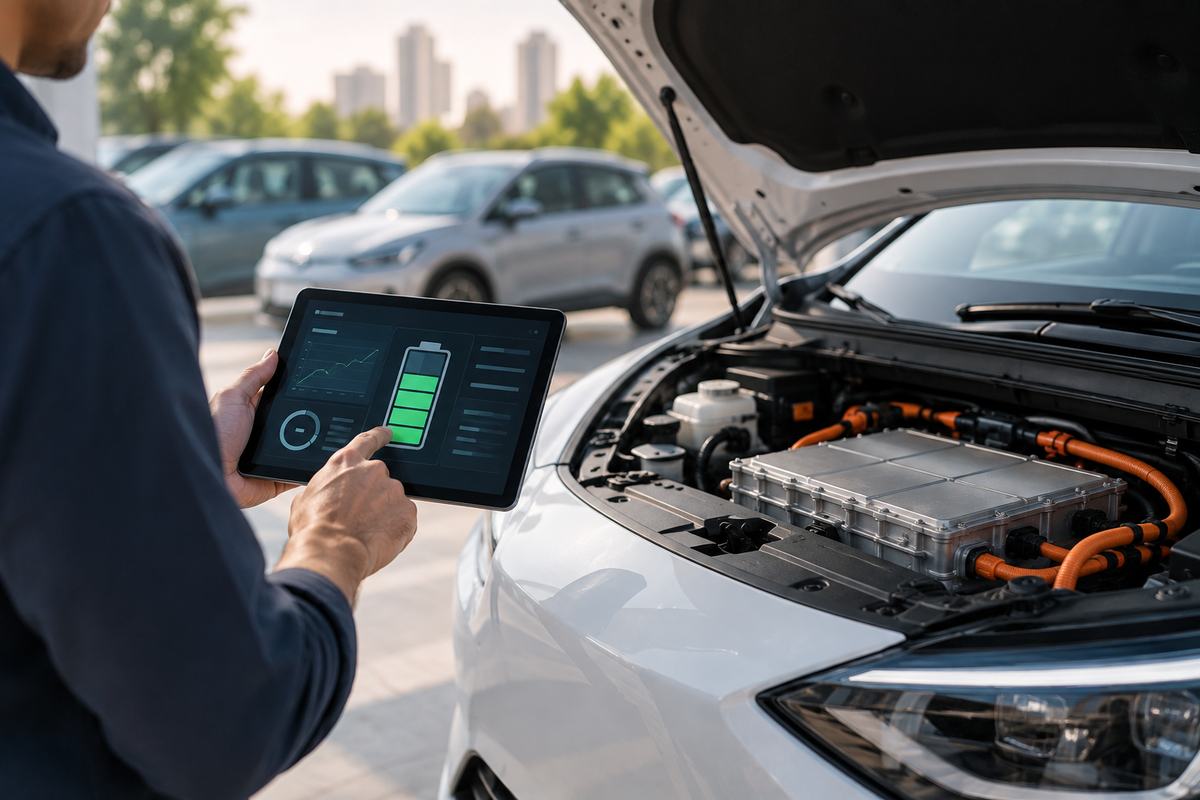

As India’s pre-owned EV market grows, battery condition is becoming the key variable in determining a vehicle’s resale value. Industry executives say a standardised State of Health certificate could reduce uncertainty for buyers and financiers.
Buying a used EV requires a different kind of due diligence from buying a conventional vehicle. Mileage and service history still matter, but battery condition can directly influence range, performance, replacement costs and residual value.
State Of Health Must Become Standard
State of Health, or SoH, measures a battery’s remaining usable capacity relative to when it was new. Unlike the State of Charge shown on a dashboard, it gives buyers a clearer picture of long-term battery condition.
Alpna Jain, Co-Founder and Chief Business Officer, Drivn, said, “What matters for resale is state of health: the vehicle’s usable battery capacity compared with its original capacity. That requires data pulled directly from the battery management system, not reliance on a seller’s verbal claim.”
A credible assessment must go beyond a physical inspection. Sahil Jindal, Co-Founder, Trevel, said, “Ask for a State of Health report pulled from the battery management system, not a visual check. Review charging history, especially fast charging frequency, and confirm the remaining battery warranty in writing.”
Battery history matters because similar SoH readings can mask different usage patterns, charging behaviour and fault records.
Abiram Menon Methil, CEO, Magron Novus, said, “Buyers should have access to verified BMS data, State of Health, charging history, degradation levels and fault records. Equally important is transparency around warranty coverage and replacement costs.”
Certification Could Improve Valuation
Standardised battery-health reporting could also help lenders value used EVs more consistently. At present, uncertainty around remaining battery life and potential repair costs makes residual-value assessment more difficult.
Surendar Nath, Executive Director, ETO Motors, said, “Buyers should insist on a certified Battery State of Health report, supported by BMS diagnostics, charging history, cell balance and fault records. Warranty validity and transferability should also be verified.”
Over time, such certification could be supported by digital lifecycle records covering battery usage, repair history and eventual refurbishment or recycling.
For the used-EV market to scale, battery condition has to become as transparent and comparable as mileage and service history are in conventional vehicles. A common health certificate could be the first step towards making that possible.