
A rooftop system can cover most or all of a typical Indian home's electricity needs. Whether it actually does depends less on the panels than on four things homeowners rarely check: how many units they use, when they use them, how much they run at the same moment, and how the system is connected.
"Will solar run my whole house?" is the first question almost every homeowner asks. It is also the question most often answered badly — either with a cheerful yes from an installer eager to close the sale, or a vague "it depends" that leaves the buyer no wiser.
The honest answer is more useful than either. For most Indian homes, a correctly sized rooftop system can generate as much electricity in a year as the household consumes. But generating enough and powering everything are not the same thing. The gap between the two is where good planning, and good equipment, earn their keep.
Kilowatts are not units
Most confusion starts with two terms that sound alike. A system's capacity is measured in kilowatt-peak (kWp) — the most power its panels can produce under standard test conditions of strong sunlight. A home's consumption is measured in kilowatt-hours (kWh), the "units" printed on the electricity bill.
The bridge between them is sunshine. Across most of India, each kilowatt of well-installed rooftop capacity produces roughly 4 to 5 units a day, and MNRE puts the figure at up to 5.5 units on a clear, sunny day. For planning, about 4 units a day — roughly 120 units a month averaged across the year — is a safe, slightly conservative figure. Sunnier states such as Rajasthan and Gujarat do better; cloudier or hillier regions, and roofs with partial shade, do worse. Monsoon months dip, summer months peak.
So a 3 kW system yields about 360 units a month across the year. That single rule of thumb — one kilowatt, about 120 units — is the most useful number a homeowner can carry into a conversation with an installer.
Start with the bill, not the roof
The right system size begins with twelve months of electricity bills. One month tells you little: a Delhi home that uses 200 units in February may cross 600 in June when two air conditioners run through the night. The annual total, divided by twelve, gives the monthly average that capacity should be matched against.
For perspective, the average Indian household uses only about 97 units a month, according to the government's 2022–23 Household Consumption Expenditure Survey. Homes with air conditioners or water heaters use several times that: smart-meter data from Prayas Energy Group found such households in Pune averaging close to 350 units a month.
The bill also reveals the sanctioned load — the maximum demand the DISCOM has approved for the connection. Rooftop capacity on a net-metered connection is linked to it. Since 2024, central rules have made this simpler for homes: applications up to 10 kW are deemed technically feasible, and the DISCOM must raise the sanctioned load to match, though the household pays the associated charges.
Beyond the totals, homeowners should think about what consumes the units. A geyser, an inverter AC, an induction cooktop and, increasingly, an electric two-wheeler or car each change both the size and the timing of demand. A home planning to add an EV next year should size for that year, not this one.
Matching capacity to the household
Applying the 120-units-per-kW rule, and allowing about 10 sq m (roughly 110 sq ft) of shade-free roof per kW, gives a practical starting point. The figures below are indicative; local sunshine, roof orientation and shading will shift them.
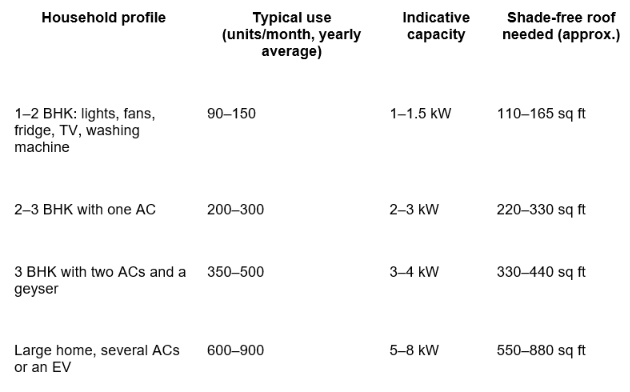
Because air-conditioner use is seasonal, these are yearly averages. A single 1.5-tonne AC running four hours a day can add 130–180 units in a summer month on its own.
The pattern is clear: for the large majority of urban and semi-urban Indian households, a 2–4 kW system can offset the year's consumption on paper. Roof space, not technology, is usually the binding limit — especially in dense apartment blocks where the terrace is shared. Higher-efficiency modules, such as TOPCon panels, help here by producing more from every square foot.
Panels decide the units; the inverter decides the load
There is a second sizing question that most buyers never hear about. The panels determine how many units a home generates over a day. The inverter — or power conditioning unit (PCU) — determines how much the home can run at the same moment.
The two are not the same. On a summer evening, a 1.5-tonne air conditioner, a refrigerator, a microwave and a water pump running together can draw 3.5–4 kW. Pumps and fixed-speed compressors, such as an older non-inverter AC, also pull a brief surge of several times their running load when they start; inverter ACs start far more gently. An inverter rated below that combined demand will trip, however many panels sit on the roof.
On a plain on-grid system, the grid quietly makes up any shortfall, so this matters less. It matters a great deal for hybrid and off-grid systems, where the inverter alone carries the house during a power cut. The practical step is to list the appliances that must keep running together during an outage, add up their load, and choose an inverter with comfortable headroom above it. A modest 3 kW array can sensibly pair with a 5 kVA hybrid inverter if that is what the household's simultaneous load demands.
The real gap is timing, not quantity
Here is where "enough units" and "powering the whole home" part ways. Solar panels produce most of their output between roughly 9 am and 4 pm. Indian homes use most of their electricity in the evening and at night — lights, cooking, television, and in summer, air conditioners running till morning. A system that generates 360 units a month may see half of them produced while the family is at work or school.
There are three ways to close that gap, and the right one depends on the household:
1. On-grid with net metering. Surplus daytime power flows to the grid and is credited against evening consumption, so the grid acts as a free battery. It is the cheapest option, and it can bring the energy portion of a bill close to zero, though fixed and meter charges usually remain. When grid power fails, however, an on-grid inverter shuts down for safety — so the home goes dark even on a sunny afternoon.
2. Off-grid with batteries. The home stores its own power and runs independently of the grid. This suits areas with weak or no supply but costs considerably more, and batteries need replacement over the system's life.
3. Hybrid. A hybrid inverter does both: it charges a battery first, exports any remaining surplus to the grid, and keeps essential loads running during outages. For tier-2 and tier-3 towns where power cuts remain routine, this is often the configuration that comes closest to genuinely powering the whole home.
One more caution on batteries: they are sized for the hours of backup and the loads that must stay on, not for the whole house. Backing up two air conditioners overnight is a very different — and far costlier — proposition from keeping lights, fans, the fridge and the Wi-Fi running.
What the brochure leaves out
Nameplate capacity is a laboratory figure. Real output depends on factors that a site survey should check before any quote is signed:
● Shading. A water tank, a neighbour's new floor or a tree can cut output far more than its footprint suggests, because shade on one panel drags down the whole string.
● Orientation and tilt. In India, south-facing panels at a tilt close to the local latitude generally perform best.
● Heat and dust. Panels lose efficiency as they heat up, and a layer of dust in a dry summer can cost noticeable output. Regular cleaning is the cheapest performance upgrade available.
● Equipment quality. Panels degrade slowly over a 25-year life; the rate depends on cell and module quality. The inverter is the system's brain, and its efficiency and MPPT (maximum power point tracking) decide how much of the available sunlight — on a clear day or an overcast one — actually reaches the home.
● Paperwork. Net-metering approval, DISCOM inspection and sanctioned load all affect when and how much a household can export.
Buying on price per kilowatt alone ignores all of this. Two systems with identical nameplates can deliver very different units over their lifetimes.
Policy has made the 3 kW home the norm
The question is no longer academic. By August 2026, PM Surya Ghar: Muft Bijli Yojana had crossed 50 lakh beneficiary households and 14.8 GW of cumulative capacity, against about 7.94 lakh rooftop installations in the entire preceding decade; by mid-September, coverage stood at about 55 lakh households. Nearly 19 lakh households now report zero electricity bills, and over 12 lakh earned a combined ₹421 crore selling surplus power in 2024–25.
The subsidy design quietly answers the sizing question for many families. Central assistance is ₹30,000 per kW for the first 2 kW and ₹18,000 for the third, capped at ₹78,000, with somewhat higher support in special-category states such as the hill and north-eastern states. That makes 3 kW — roughly 360 units a month — the natural anchor for a scheme whose promise is up to 300 free units monthly. Homes that need more must fund the extra capacity themselves, which is exactly why getting consumption right before buying matters.
The official target is one crore households by March 2027. MNRE now expects 85–90 lakh by then, partly because most buyers are choosing 3–4 kW systems typical of larger homes. Either way, the savings of millions of families now depend on whether these systems are sized and built well.
So, can it power the whole home?
For most Indian households, yes — in the sense that a rooftop system can generate a year's worth of the home's electricity. Whether it powers the home through a power cut at 10 pm is a separate decision, made at the inverter and battery stage, not the panel stage.
The homeowner's checklist is short: read twelve months of bills, size the panels at about 120 units per kW, size the inverter for the loads that must run together, plan for the appliances coming in the next few years, decide how much backup the family truly needs, and insist on a proper site survey and quality equipment. Done that way, rooftop solar stops being a hopeful purchase and becomes what it should be — the household's own power plant on its own roof.