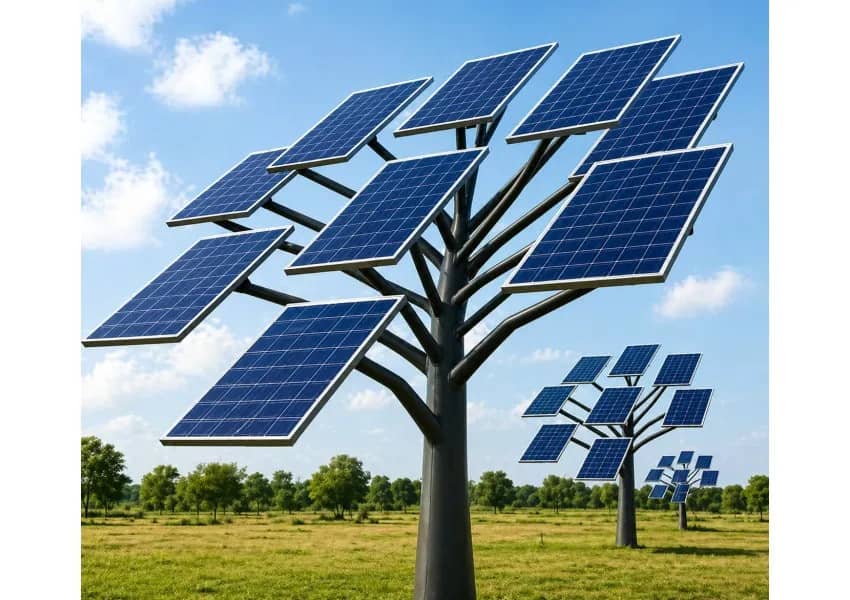

The Delhi government will install the capital's first solar tree at the Delhi Secretariat as part of a pilot project to assess the feasibility of vertical solar infrastructure in urban areas where land is scarce.
The initiative is being led by the power department in coordination with civic agencies. Officials will use the pilot to study the system's performance before considering its installation at other locations across the city.
The Delhi Secretariat has been chosen for the first installation as it houses the offices of Chief Minister Rekha Gupta, cabinet ministers and senior officials. The government expects the project to demonstrate how renewable energy systems can be integrated into busy public spaces.
Unlike conventional rooftop or ground-mounted solar systems, the solar tree uses a vertical steel structure with branch-like extensions that hold photovoltaic panels at different angles. The design enables electricity generation while occupying a much smaller footprint, making it suitable for densely populated cities.
Officials are also examining the possibility of deploying advanced versions fitted with automated sun-tracking technology, allowing the panels to adjust their position during the day to maximise solar power generation.
The electricity produced by the installation will be stored in battery energy storage systems housed at its base. The stored power will be used to operate nearby public infrastructure, reducing reliance on the conventional electricity network.
Powering Public Facilities
According to the proposal, the generated electricity is expected to support facilities such as street lights, public electric vehicle charging stations and other civic utilities located near the installation.
The project also includes a public utility component. The base of the solar tree will feature seating, creating a shaded resting space for pedestrians while combining renewable energy generation with urban infrastructure.
If the pilot achieves the expected outcomes, the Delhi government plans to expand the model to traffic intersections, public plazas and commercial areas as part of its efforts to increase renewable energy adoption and build more sustainable public spaces.