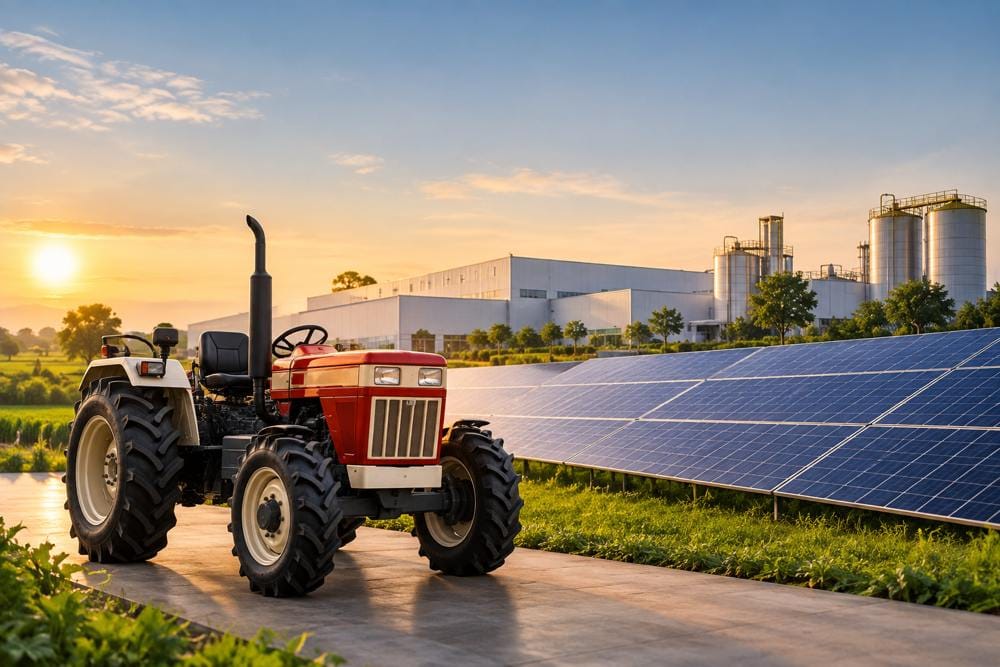

Swaraj Tractors is targeting 100 per cent renewable energy sourcing by FY30 as it steps up efforts to reduce energy intensity, water consumption and emissions across its manufacturing operations and supplier network.
The tractor manufacturer has already moved from sourcing no renewable electricity until June this year to meeting 50 per cent of its energy requirement through solar power in partnership with Mahindra Susten. The transition is anchored by a group-captive solar project in Bathinda, Punjab, which will supply renewable electricity to Swaraj's manufacturing operations.
In an interaction with BW Businessworld, Gaganjot Singh — Chief Executive Officer, Swaraj Division, Mahindra & Mahindra Ltd. said the company's sustainability roadmap is built around six broad priorities covering energy efficiency, renewable energy, waste, water, its supplier ecosystem and Scope 3 emissions. Avinash Rao — Managing Director and CEO, Mahindra Susten. said the partnership marks Susten’s first group-captive renewable-energy project and could eventually open up a new business opportunity with other industrial customers.
“From a baseline of FY19, we aim to reduce our energy intensity by almost 50 per cent,” Singh said. “The second ambition is around the energy we source. We want to move to 100 per cent green, renewable energy by 2030.”
The other targets include zero waste to landfill and becoming water positive, alongside helping suppliers transition towards renewable energy and reducing Scope 3 emissions associated with the company's sourcing.
Energy Intensity Down 33% From FY19 Baseline
Swaraj has already reduced its energy intensity by around 33 per cent against its FY19 baseline, translating into an approximately 5 per cent year-on-year reduction in energy consumption.
The company was also recognised with the Golden Peacock Award for energy efficiency in 2026.
Singh said Swaraj has already achieved its 2030 zero-waste-to-landfill target. On water, the company currently replenishes twice the amount it consumes through measures including rainwater harvesting and ponds around its manufacturing facilities.
“If we consume 100 litres, we put 200 litres back into the ground through measures such as rainwater harvesting and ponds around our manufacturing facilities,” he said.
The company is at an earlier stage when it comes to greening its supplier ecosystem and reducing Scope 3 emissions.
Swaraj has around 400 suppliers across Punjab and Haryana, some of which have been associated with the company for nearly five decades. It plans to gradually extend renewable-energy sourcing to this network.
The process is beginning with Swaraj Engines, one of its major suppliers, which is also expected to source 50 per cent of its energy requirement from Mahindra Susten.
“Our ambition is to expand what we are doing with Susten to our suppliers as well,” Singh said. “We then intend to expand this across our supplier base, which is predominantly located in Punjab and Haryana.”
From Zero Renewable Power To 50% In Months
Until June 2026, none of Swaraj's energy requirement was met through renewable sources. It is now moving to 50 per cent, with an eventual target of 100 per cent by FY30.
Singh said the target is aligned with the Mahindra Group's Planet Positive ambition.
Regulatory restrictions currently limit how far the company can increase renewable-energy sourcing, according to Singh. Recent notifications could allow Swaraj to increase the share to around 60 per cent in the short term.
“The reason we are at 50 per cent today is that government regulations currently do not allow us to go beyond that level. Recent notifications should allow us to move to around 60 per cent in the short term,” he said.
Over time, the company intends to work with the government and Mahindra Susten to move towards almost 100 per cent renewable energy.
The Bathinda project will account for 50 per cent of Swaraj's energy consumption, reducing its reliance on the existing grid electricity mix and lowering corresponding carbon dioxide emissions.
Solar-Storage Combination Could Drive Next Phase
Mahindra Susten sees energy storage as an important part of the next stage of Swaraj's renewable transition.
Gaganjot Singh of Swaraj Tractors said the company would look beyond conventional solar supply as regulations evolve and Swaraj increases its renewable-energy consumption.
“It is not just about plain-vanilla solar. We also have to look at how we integrate solar with storage and offer them a much straighter generation profile rather than the bell-shaped generation profile that solar offers today,” Rao said.
Susten plans to continue working with Swaraj as it attempts to increase the renewable share of its energy portfolio.
Singh also linked the project to the agricultural value chain, with renewable power being used to manufacture equipment ultimately deployed by farmers.
“Farmers produce so much of the food we consume, and we can now help produce the tractors they use with green energy. It is a novel proposition, both from a business perspective and more broadly,” he said.
Storage Is A ‘Must-Have’
Battery storage will become essential as India expands renewable generation, even as the country remains dependent on imported battery technology and raw materials.
“At a fundamental level, I don't think storage is a question mark anymore. It is a must-have,” Rao said.
He compared the evolution of battery manufacturing with India's earlier experience in wind and solar. India initially relied substantially on imported technology and equipment in both sectors before gradually developing domestic manufacturing capacity.
When India's wind industry was developing, the country depended significantly on Danish turbines, while the early solar industry was heavily dependent on China. Government initiatives and expanding demand have since helped India build solar manufacturing capacity, with the possibility of domestic module capacity moving into surplus.
“Batteries will have to go through a similar journey,” Rao said.
India's potential advantage is the scale of its emerging storage market. A sufficiently large domestic market could provide manufacturers with the incentive to establish and expand local production capacity.
Technology development could also alter India's dependence on imported battery materials. Lithium-ion remains the dominant technology because of its efficiency and established commercial performance, and domestic lithium-ion manufacturing capacity is expected to develop further.
At the same time, newer technologies such as sodium-ion could provide alternatives. Rao pointed to companies such as CATL announcing significant plans around sodium-ion batteries and noted that the greater availability of sodium could reduce dependence on imported raw materials.
“With India's 500 GW renewable-energy ambition, there is no reason storage should remain a question mark. It is a necessity, and we have to go down that path,” he said.
Replacing Thermal Power With Solar
Punjab's grid electricity is predominantly supplied through a combination of thermal and hydropower. Swaraj's renewable-energy strategy is focused on replacing a portion of its coal-based electricity consumption with solar.
Rao said hydropower is already part of the grid electricity consumed by Swaraj, while the state must balance thermal, hydel and solar generation.
Coal presents an additional challenge for Punjab because it is not produced locally and must be transported from mines in central and eastern India.
“Coal is not found in Punjab. It has to be transported from mines in central or eastern India all the way to Punjab for consumption. That is neither the most sustainable nor the most efficient model, particularly when the state is blessed with significant solar resources,” Rao said.
Punjab has relatively limited wind potential but significant solar resources, creating an opportunity for greater solar deployment by industrial consumers.
Rao described Susten's project as one of Punjab's major captive renewable-energy projects and said it could provide a model for other industries in the state while contributing to India's 500 GW renewable-energy ambition.
Water Consumption Per Employee Falls Sharply
Beyond switching its electricity supply, Swaraj is working on reducing the amount of energy and water consumed within its manufacturing facilities.
Energy-conservation measures across its plants have contributed to the reduction in energy intensity and the company's Golden Peacock recognition.
On water, Swaraj separates consumption into water used by people at its facilities and water required for industrial processes.
Human water consumption has declined from around 70 litres per person in 2019 to approximately 30 litres today.
For process water, the company is replenishing twice the amount it consumes through rainwater-harvesting systems across its locations and rejuvenation ponds around manufacturing facilities.
“For us, that is a significant step forward as an industry — reaching a point where we can say that we are putting more water back into the ground than we consume,” Singh said.
Suppliers Are The Next Frontier
After reducing its own energy consumption and beginning the transition towards renewable electricity, Swaraj sees its supplier ecosystem as the next major area for decarbonisation.
The company intends to work with Susten to expand renewable capacity that can eventually serve suppliers across Punjab and Haryana.
“We are working on expanding capacity so that our suppliers can also source renewable power. That is going to be the next frontier for us,” Singh said.
This is also expected to support Swaraj's efforts to address Scope 3 emissions, an area that in general is a challenge for all companies in India.
Mahindra Susten Building Another 150 MW For Auto And Farm Businesses
Mahindra Susten is simultaneously exploring opportunities to provide renewable energy to other Mahindra Group businesses.
The company is developing another 150 MW of renewable capacity for the group's auto and farm businesses. The first phase is expected to be commissioned later this year.
“We are also working with other group companies to explore the synergies that exist and how we can support their transition, subject, of course, to related-party restrictions,” Rao said.
Any such arrangement would have to work commercially for the individual group companies and their respective shareholders, he added.
For Mahindra Susten, the Swaraj project also represents a change in its business model. The company has traditionally operated as an independent power producer selling electricity to utilities. The Swaraj project is the first group-captive project it has commissioned.
“This particular project is important because Susten has traditionally sold power to utilities as an independent power producer. This is our first group-captive project that we have commissioned, so it has given us significant learnings,” Rao said.
Those learnings could eventually allow Susten to take the model outside the Mahindra Group.
The immediate priority is to meet Swaraj's renewable-energy requirements and successfully execute other internal group projects. If the model proves successful, Susten could selectively pursue group-captive renewable-energy opportunities with third-party industrial customers.
“If we are able to win Swaraj's trust and demonstrate the success of this model, there is no reason we cannot replicate it with reputed third-party clients,” Rao said. “That creates a new business line for Susten.”
The company will therefore first focus on completing its internal projects and meeting Mahindra Group requirements before using the experience to evaluate renewable-power supply opportunities with other group-captive customers.